News and blogs on our products, services, and events
Recently active
By Evelien Duizer and Marjolein van der Vegt-Verstraten Let us start with a question: Do you know what software testing means, and what a software tester or a software test engineer is up to all day? Let’s be honest, most people, whether they work in IT or not, would answer this question with a resounding ‘no’. But isn’t that a bit strange? For most professions, the average person has a pretty good idea of what the job includes. A teacher educates students, a police officer enforces the law, and a doctor treats diseases. People can even hazard a good guess about what software developers do. They create websites, applications, and video games. So what does a tester do? First and foremost, a tester is responsible for increasing and guarding the quality of a system. This involves a lot more than people think. A tester has to find out how functionality should work, analyze the differences between the actual and desired situation, create test plans and scenarios, analyze risks, report test
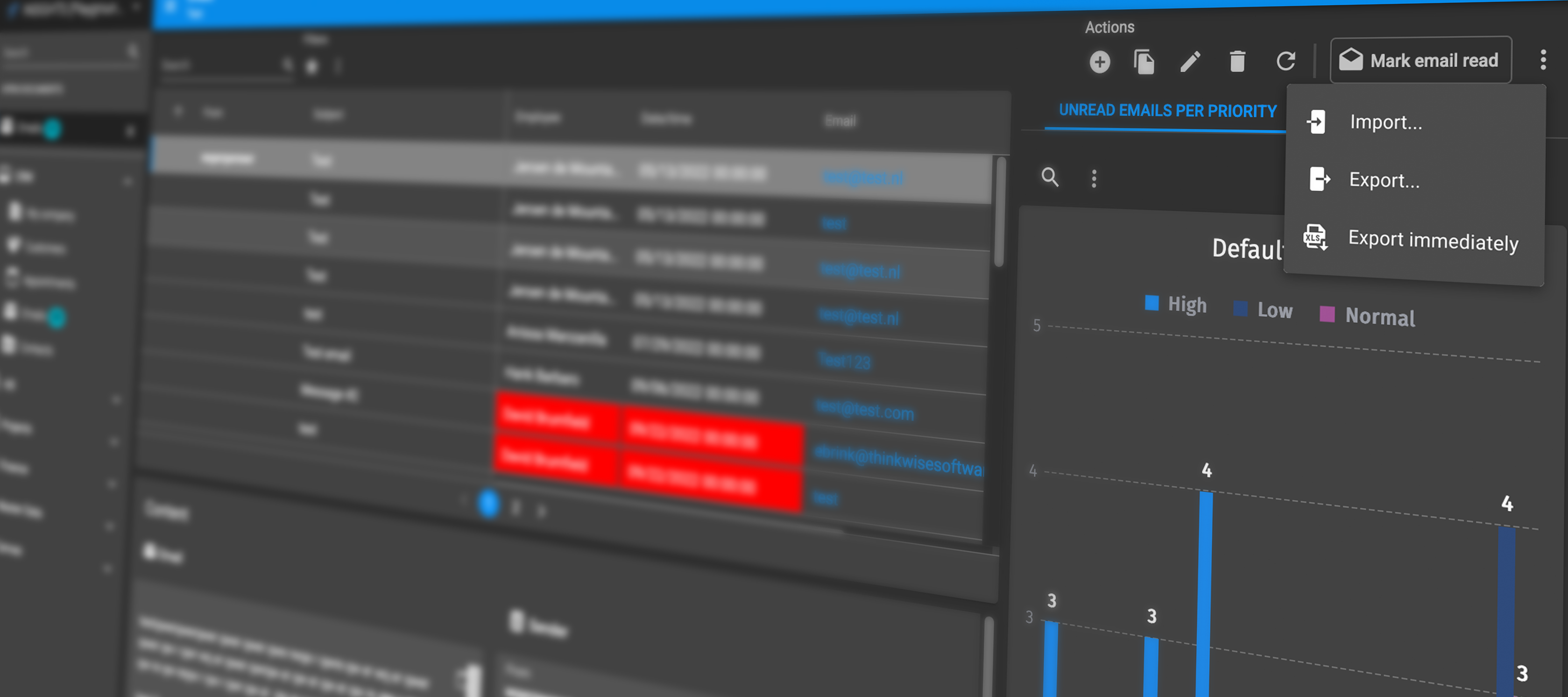
This is the first time we share a design as a standalone blog, to give you an impression of the things yet to come. This gives us the means to register feedback about a new feature in a natural way, which helps us to improve our product in the process. Our goal is to give our end-users a prominent place in our design process and to listen to their feedback in an earlier stage, so that we can work together to make the best product possible for all involved.Therefore, we welcome your opinion and are curious about your thoughts.Now, for the design at hand. We already support the immediate export functionality in the overflow menu of a subject. Using this action immediately starts the download of all visible rows without any further action needed.But what if you want to download a specific number of rows or want to download the data as untranslated ID’s?We are going to add an ‘Export…’ action in the overflow menu, which opens a wizard. This wizard lets you adjust your export settings, step
Although the 2022.2 version of the Thinkwise Platform has only just been released, we already have big plans for a major change for the 2023.1. We are planning to store only the latest version of every project and move all old data to history tables.The main goal of this change is performance improvement by separating the operational data in the Software Factory from the non-operational data. A secondary goal is preventing massive amounts of unnecessary data from being stored.In the 2022.2 and earlier versions of the Software Factory the version control was handled by making a copy of a complete model in the shape of a project version. This resulted in largely the same data being saved multiple numbers of times, whenever a new project version or branch was created. Since the changes only make up a small percentage of the whole model, this unnecessary data caused the Software Factory databases to grow over time and becoming slower due to their size.The change that is intended is to star
The Thinkwise Platform provides extensive, out-of-the-box support for the DB2 for IBM i database management system for many years already. That is why we have a large number of customers that successfully use the Thinkwise Platform to modernize their legacy DB2 application landscape. This is also recognized by IBM, who named Thinkwise as Best IBM Business Partner of the Year in Europe in 2009, and awarded one of our customers with the Most Innovative IBM i User of the Year award because it used the Thinkwise Platform.However, IBM did (and still does) not make things easy for us.When we started, IBM was still in the process of replacing their Classic Query Engine (CQE) with the much faster and more powerful SQL Query Engine (SQE), and we have been in regular contact with IBM about bugs in these query engines that nearly drove us insane. With the necessary adjustments and bug fixes by IBM and some workarounds in the Thinkwise Platform, we were able to solve these problems, and the Thinkw
The Thinkwise Platform allows applications to stay functionally and technologically up-to-date. This is at the core of our mission.Free the world of legacy softwareTo keep this promise, we must eventually remove support for runtime components that use aged technologies or architectures. While they are supported, they may hamper further architectural developments of the Thinkwise Platform and take up valuable development time. Support for modern deployment scenarios, operating systems, and browsers becomes difficult and ultimately impossible.Most importantly, as technology ages, it poses an increased security risk. For any technology, some vulnerabilities may be discovered. While these can be resolved quickly for modern technologies, framework developers and component vendors eventually discontinue support for older technologies. This puts applications that use these technologies at risk. An application using the 2-tier Visual Basic 6 GUI. Support for this user interface was discontinu
SQL server version 2016 has introduced the feature of setting up system-versioning to tables (also known as ‘system-versioned’ temporal tables). This means that SQL server stores a history of data changes and deletions which take place within a table. There are various methods of creating history tables, but with SQL server you can allow a history table to be made automatically for a table. To build a test scenario, let’s first create a table called article. code:create table article(article_number varchar(10) not null,article_name varchar(100) null,article_price numeric(9,2) null,constraint article_pk primary key clustered(article_number asc)) In order to create a history table, SQL first needs start_date_time and end_date_time columns on the table which is to be logged. code:alter table articleadd start_date_time datetime2 generated always as row start hidden not null default '1900-01-01 00:00:00.0000000', --Can be anything, but has to be in the past. end_date_time datetim
We are thrilled to introduce a great new feature. We received quite a few requests to apply some more possibilities to start user actions from a grid record, like we see also in apps like Outlook, Gmail, etc. Our Web GUI already supports grid links, where a column with a textual link can start a task based on the clicked record. We plan to support this feature in our Windows and Universal GUI soon too. In the future, we will also provide options to display the link in a nicer way, using icons and tooltips. More about that in a later blog post. Recently we’ve added a similar cool feature to the grids of our Windows and Web GUI’s: Grids now support a task to be executed when a record is double-clickedTo configure which tasks to use, the SF offers a new (model) extender, released in a recent hot-fix, which can be used to assign multiple table tasks to the double click action. The GUI will choose the first enabled task to execute. We chose to allow more than one so the developer can dete
One of the main goals for the Thinkwise Platform is to enable developers to focus on the functional aspects of software development instead of the technical aspects. To allow developers to leverage machine learning with minimal technical hurdles, we've added AutoML to the Thinkwise Platform in version 2020.2! Machine learning Machine learning combines software engineering with the field of mathematics and statistics to create algorithms that can learn from experience. To apply this in the field, data scientists use domain knowledge to apply these algorithms to create machine learning models that can make estimates and predictions based on the knowledge gained from experience. In applications built with the Thinkwise Platform, experience is often existing historical data. Machine Learning techniques in these applications are often leveraged for calculations that are difficult or impossible to express with regular code. Some examples include: Demand predictions over time Project cos
Most of us probably have been in the situation where you wrote a time-consuming SQL stored procedure for a task or designed a report that takes a long time to create, knowing that your users will have to wait until everything is done before they can continue working in the GUI. The same goes for tasks or reports that are executed on multiple rows at once. Waiting for an hourglass to stop spinning is very boring so users will lose their patience and look for alternative ways to finish their work. You can put a progress dialog on it showing the users how long they will need to wait. But what if a task will take minutes or even hours? Maybe we would start multiple GUIs at once to split the work that needs to be done and visit the blocked GUI occasionally to watch the progress. We could lose some valuable time here not knowing exactly when the time-consuming action will finish exactly. How cool would it be when the user could simply continue their work after starting their action, and st
The Thinkwise Platform has powerful functionality to connect to external applications using OAuth. Customers often use external applications, for example a payment system. In that case they often want to import the data to the Thinkwise database, as the external system is their single source of truth. We can use the Thinkwise Platform to synchronize this data. With the support of system flows we can even automate this to automatically collect the latest data.In this blog I will use Exact Online as the external application to synchronize the projects from Exact to a database.Creating the data modelI made a very simple model for demo purposes. As a developer you can extract a lot more data from the API.The data model contains two tables, the oauth_token_info table to save the OAuth access and refresh tokens. The project table contains the information we will extract from the Exact Online API.Data modelApp RegistrationTo call the API first we need to register an application in Exact Onlin
IntroductionSince the release of version 2020.1 of the Thinkwise platform, the combination of Indicium and IAM forms a full-fledged authentication provider that implements the OpenID Connect protocol. This means that third party applications can authenticate their users through the Thinkwise platform. Starting with the next release of Indicium Universal (2020.2.9), the Thinkwise platform also supports authenticating its users through third party authentication providers that support OpenID Connect. This makes it possible to authenticate users through Azure Active Directory, Google, GitHub, Facebook and many other authentication providers.What is OpenID ConnectOpenID Connect is an industry standard protocol that allows for applications to delegate the authentication of users to a so-called Identity Provider. Common examples of Identity Providers are Microsoft, Google and Facebook. Whenever you see that button “Sign in with Google” on a website or an app on your smartphone, it means that
A lesser-known feature of Indicium is its capability to automatically log to Azure Application Insights. This service can be used for monitoring Indicium live. You can, for example, inspect failed requests, monitor response times, or investigate exceptions.Read the example below to learn how Azure Application Insights can help you in the development process. Especially when you don't have direct access to Indicium's error logs, having such logging capabilities is extremely useful. But even when you have direct access to the log files, the extra features offered by Azure Application Insights make it worth enabling it. Setting up Azure Application InsightsThis feature is enabled by default, but to use it, you need a paid Azure account with Application Insights enabled as a resource.Once you have everything set up in Azure, the next step is to find your Application Insights instrumentation key and add it to Indicium's appsettings.json.Instrumentation key"ApplicationInsights": { "Instrumen
Too few developers create their own custom validations and solely rely on the default validations offered by the Software Factory. Though this default validation set is already great for higher quality, there is always room for improvement, especially in certain situations.Developers tend not to make custom validations for several reasons:The functionality is unknown Development itself has more priority Validations are not being used at all Developers think creating a validation is difficultTo stimulate the use of custom validations, we created a video in which we show an example. We hope this motivates you to create your own validations. Create a custom Validation in the Thinkwise Software Factory
The release notes have been moved to a new area: Product updates.Don't forget to subscribe there!
At Thinkwise, we strive to make development and maintenance of enterprise applications as easy as possible. But in the end, an operational application will have a lot of moving parts. Performance troubleshooting comes down to identifying and resolving a problem in one of those many moving parts.Unfortunately, most of the time it ends up in a witch hunt. Kick in every virtual door to find out what causes the curse. This makes performance troubleshooting very time- and resource intensive. Today, I’ll share a very focused approach to resolve performance issues.The title of this blog might as well be: How to avoid the red herrings! Performance troubleshooting processThere are many ways to approach performance troubleshooting. This blog uses a certain script that can be used and adapted for your own needs. The script assumes a single, agile development team working on an application.The script for performance troubleshootingI’ll go into detail for all the steps, but I’d like to start off wi
Your input and feedback are incredibly valuable to us. That is why we devote a significant part of our capacity to implementing the great ideas posted and voted on by our amazing community. But how many of your ideas are actually being taken up?In this post we want to give you some insight into the number of ideas and votes that we have investigated, worked on, and delivered in 2021.Quick statistics for ideasSome figures about the ideas and votes in 2021:61 ideas delivered 🚀 252 new ideas created 💡 563 votes delivered 🚛 2029 votes added 💗Since the start of the Thinkwise community in 2019, we have managed to deliver no less than 23% of all votes cast! And this percentage is still steadily increasing, as the great ideas keep coming in.So once again, a big thank you to everyone in the Thinkwise Community who shares ideas and votes for other customer ideas. We greatly appreciate the insights and feedback you give us about our platform.Thinkwise Community dashboardIdeas we deliveredThes
Update - jan-27The problem has been resolved.All new installations of the Thinkwise Platform will once again deploy properly on Azure databases.Platform upgrades from 2020.2 and up have been adjusted to not re-introduce the conflicting data type.Existing installations up until 2020.2 have a service fix available that will phase out the json user-defined data type.------------------------------------- An undocumented (or unintended) changeSomewhere around the start of this year, Azure has introduced a change to the managed SQL Server databases regarding user-defined data types. The change did not affect any existing databases but prevents deploying any databases which use a user-defined type named json as an Azure SQL Server database.The change has occurred overnight and we have yet to trace it back to a specific Azure Database update. So far, we have not been able to find any documentation regarding this change either. No versions of on-premise SQL Server databases seem to be affected
Hi everyone,We previously explained how the Thinkwise Platform version 2021.3 revised the way creation and automation works.In the Thinkwise Platform version 2022.1, we also revised the way the Synchronization to IAM (Intelligent Application Manager) and Deployment package screens work, allowing for seamless integration in CI/CD tools that many have been waiting for.The Synchronization and Deployment processes are the final two processes that now have been made to fully run via Indicium and therefore can be initialized via Indicium's API. More on that later in this blog.In the previous version, the steps in these screens were bound to a specific client. A developer would start to Synchronize to IAM and the synchronization would be orchestrated start-to-end by the user’s client. This also applies for the Deployment package process. This has served us well for many years, but there are some drawbacks that we’ve addressed in this release. The new approachAll ‘jobs’ are no longer performed
The Thinkwise Platform supports various types of report generation solutions. The choice for a certain type of reporting has functional implications. For instance, not all reporting solutions support the usage of sub-reports. Other reporting solutions may offer more features regarding the use of SVG images or HTML markup.There are also non-functional aspects to consider. License costs is often noted. Another important aspect is the portability of the reports. Not every type of report can run on both Windows and Linux environments.Quite some research has gone into the portability of the usage of Crystal Reports lately. We’d like to share some of our findings in this blog.Runtime installationAdministrators who have deployed applications using Crystal Reports know that it requires the installation of the Crystal Reports runtime. Either on the desktop clients when the Windows GUI is used or on the web server when the reports are generated by Indicium, the Application Tier, or the Web GUI.A
You have probably heard about the critical vulnerability found in the Apache Log4j library in the past few days, which is used by millions of Java applications for logging error messages. This vulnerability, CVE-2021-44228, is a Remote Code Execution (RCE) vulnerability that allows attackers to gain full access to a system.The Thinkwise platform does not use Java and is therefore not subject to this vulnerability.Thinkwise does advise its customers to check whether other applications or services use the affected library and to take appropriate steps to prevent abuse.At Thinkwise, we closely monitor the security of all third party libraries and components used in our platform, and notify our customers if any vulnerabilities are reported.
Written by Erik Brink/Diana Kuipers New developments require new knowledge and skillsets for Software Factory developers. For example, Thinkwise is constantly improving the process of troubleshooting unexpected behavior of our tooling.Since more and more organizations are using the Universal GUI, we would like to tell you more about the best practices in troubleshooting the Universal GUI in our 3-tier environment. So, in this blog, we will teach you about the tools that can help you solve possible problems in the logic executed by the Universal GUI's backend and its interaction with the Indicium data/service layer. The following tools and log files are available to support you:Extensive information on the tools and logs mentioned below is available in the Thinkwise Docs, chapter Tools for troubleshooting Universal GUI. The same manual also contains more information on Troubleshooting Universal GUI deployment.DevTools: the Universal GUI is a web application. Therefore, you can use the
Hi everyone,For the 2021.3 release, the complete Creation process has been overhauled to be fully run by Indicium. There was one other feature on the backlog that was very valuable to the Generate definition process, and now was the perfect time to implement it. When generating, all generated program objects would be dropped and re-created by the control procedures. This process costs performance and IO. It would be smarter if objects were not simply dropped and re-created, but instead created/changed/dropped only when that truly applies. StrategiesTo improve the Generate definition process, several generation strategies have been implemented. A Strategy is a defined way of how the Software Factory should generate the control procedure. For every strategy there can be reasons to choose one over the other, but it is recommended to use the Staged strategy due to all its performance benefits. Read on to see how to implement these new strategies. The following strategies are now available
The low-code market has developed quickly in recent years. Current events have put pressure on IT leaders to dramatically increase application delivery speed, even more than before. The COVID crisis has certainly demonstrated that the constant continued development of software is crucial.Want to know how you can improve the agility of your business and adapt quickly to changing circumstances and market opportunities using a low-code platform? Discover how Thinkwise enables you to modernize large, business-critical applications, with extremely high speed of development and flexibility, during our first Low-Code Summit on 13 October 2021.Time: 09:00 to 15:00 CEST Location: Online Admission: free of chargeSign Up NowWho should attend?Those new to low-code and looking to learn more about enterprise low-code for mission-critical systems (what is and how to get started). Business Executives: Hear directly from other business leaders on their approaches to adopting low-code for core systems f
In our previous blog, we discussed why we came to the conclusion that translating natural language into a formal language is the best approach for us to create linguistic interfaces for Thinkwise applications. It was mentioned that an existing project called Genie follows this approach and we decided to build a prototype to test whether or not Genie is the best framework for us. The purpose of this blog is to share our story about how we built our first prototype using the Insights demo application. The prototype is available at (https://nlpdemo.thinkwise.app/)To make it more formal, for our prototype we need to construct a neural semantic parser from the Insights data model using Genie.A semantic parser is basically a tool that can translate from natural language into a machine-understandable form. In our case, this will be a translation to the ThingTalk Virtual Assistant Programming Language (VAPL). The term neural refers to the fact that the generated semantic parser is a large neur
Already have an account? Login
Enter your E-mail address. We'll send you an e-mail with instructions to reset your password.