

Open

Automatically assigning validations within feature branches

Related products:Software Factory
  • April 23, 2024
  • 8 replies
  • 148 views

Forum|alt.badge.img+3

In our project, we employ feature branches where each developer works on their own feature. From a quality perspective, we aim for each developer to be accountable for all pending validations within their branch.

Therefore, we seek to automatically assign all new validations within the branch to the developer of that branch if they are not already allocated. It would be practical to specify this on a per-branch basis, as there may be instances where multiple developers are working within a single branch.


8 replies

Jeroen van den Belt
Administrator
Forum|alt.badge.img+10

Hi @Martin,

Thank you for your input. Administratively, this approach seems logical.

However, could you provide further details on the process-related advantages it offers? Whether all validations are assigned to oneself or left unassigned, they are both immediately visible upon accessing the validation screen by default. Therefore, I'm questioning the additional functional value in this situation.


Robert Jan de Nie
Thinkwise blogger
Forum|alt.badge.img+7

The function is that if you merge before all validations have been solved (you shouldn’t, but hey, sometimes it happens :) ), you can still see to whom these validations belong.


Forum|alt.badge.img+3
  • Author
  • Thinkwiser
  • April 24, 2024

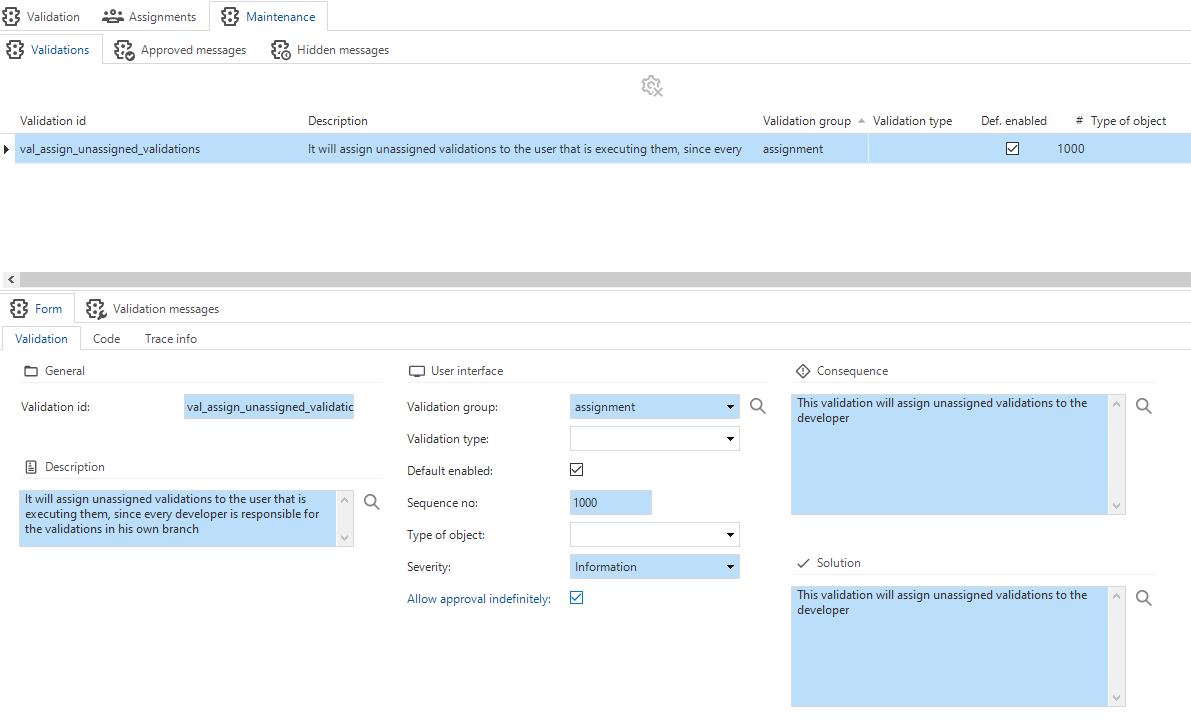
Currently, we have solved this by creating an additional validation step that is executed last and assigns all unassigned validations. For this validation we created a new validation group with the highest sequence no to make sure it is executed after all the other validations.


In the code we made an extra check to make sure the validations are only assigned to the developer that is executing the validation job. Not sure if this is the best way to deal with this, but it works for us.  

-- declare parameters
declare @developer_id name
,@cur_validation_id validation_id
,@pk_hash hashbytes_md5

-- get the developer executing the validation
set @developer_id = (
select top 1
developer_id
from job j
where job_type = 1 -- validation
and job_status = 2 -- running
and finish_date_time is null
and exists (
select 1
from usr u
where u.usr_id = j.developer_id
)
order by 1 desc
)

-- if the developer exists then start assigning
if @developer_id is not null
begin
-- get all unassinged validations
declare cursor_assign_validation cursor for
select v.validation_id
,vm.pk_hash
from validation_msg vm
join validation v
on v.model_id = vm.model_id
and v.branch_id = vm.branch_id
and v.validation_id = vm.validation_id
where vm.model_id = @model_id
and vm.branch_id = @branch_id
and not exists (
select 1
from validation_msg_assigned vma
where vma.model_id = vm.model_id
and vma.branch_id = vm.branch_id
and vma.validation_id = vm.validation_id
and vma.pk_hash = vm.pk_hash
)

open cursor_assign_validation
fetch next from cursor_assign_validation
into @cur_validation_id
,@pk_hash

while @@fetch_status = 0
begin
-- execute software factory assign task
exec task_assign_validation @model_id
,@branch_id
,@cur_validation_id
,@developer_id
,@pk_hash

fetch next from cursor_assign_validation
into @cur_validation_id
,@pk_hash
end
close cursor_assign_validation
deallocate cursor_assign_validation
end


Mark Jongeling
Administrator
Forum|alt.badge.img+23
  • Software Architect
  • April 24, 2024

To add here, the moment of assigning them to the developer is also up for debate. My suggestion would be: after executing validations, that any messages that come out are automatically assigned to the one executing the validation.

However, developers could opt to not validate at all and merge any changes to another branch, causing validation messages to appear in that branch and being assigned to a developer that does not know where these messages come from. How should the Software Factory deal with this situation in your opinion?


Robert Jan de Nie
Thinkwise blogger
Forum|alt.badge.img+7

To add here, the moment of assigning them to the developer is also up for debate. My suggestion would be: after executing validations, that any messages that come out are automatically assigned to the one executing the validation.

However, developers could opt to not validate at all and merge any changes to another branch, causing validation messages to appear in that branch and being assigned to a developer that does not know where these messages come from. How should the Software Factory deal with this situation in your opinion?

I think part of the requirement for merging is having had a validation run. Or even run it as part of creating the merge session…

‘create-merge-session’ → start validating → warn if there are any and ask if user wants to continue → do the actual merge-stuff.

I mean, it does not make sense to not run your validations before merging. Make it mandatory.


Dave Bieleveld Starcode
Vanguard
Forum|alt.badge.img+2

What about automatically assigning the validation to the one that created or mutated the related object? I think that would make much more sense.


Dave Bieleveld Starcode
Vanguard
Forum|alt.badge.img+2

What about automatically assigning the validation to the one that created or mutated the related object? I think that would make much more sense.


Mark Jongeling
Administrator
Forum|alt.badge.img+23
  • Software Architect
  • April 29, 2024
NewOpen