Solved

Get column translations via API

  • Nov 24, 2026 10:20 AM UTC
  • 5 replies
  • 20 views

K.Bakkenes
Captain
Forum|alt.badge.img+9

Hi,

Our BI-team is looking for a way to retrieve all column translations for certain tables of our application.
I've searched the docs but can't find any Odata API endpoints for this.

Is there a view in IAM that is accessible for API calls?

Best answer by Jochem Pieper

Thanks for the follow-up! The column col_id_transl is the standard translation (transl). If the column uses an alternative label, that one is already applied, so you get what the user actually sees.

The grid and form labels are in separate views, with the same keys as i_ui_col:

  • i_ui_col_grid → grid_transl
  • i_ui_col_form → form_transl

For example:

{{indicium_url}}/iam/iam/i_ui_col_grid?gui_appl_alias={{gui_appl_alias}}&$filter=tab_id eq 'trade_item'&$select=tab_id,tab_variant_id,col_id,grid_transl

There is no plural for columns as that only applies to tables. For the table itself (the tab_id in your query) you can get both the singular and plural translation from i_ui_tab:

{{indicium_url}}/iam/iam/i_ui_tab?gui_appl_alias={{gui_appl_alias}}&$filter=tab_id eq 'trade_item'&$select=tab_id,tab_variant_id,tab_id_transl,tab_id_transl_plural

One tip: these views return a row per table variant. Add and tab_variant_id eq '' to your filter to get only the default (non-variant) labels, if you use table variants in your situation at all.


View original

5 replies

Jochem Pieper
Moderator
Forum|alt.badge.img+3

Hi there!

There's no dedicated endpoint for translations, but you can get them through the IAM API. IAM is itself a Thinkwise application, available at <indicium-url>/iam/iam/.

You need two entity sets:

  • col: the columns per table
  • transl: the translations per language

Column translations in transl have type_of_object = 1, and their transl_object_id is the column id. You can't join them in a single OData request, so retrieve both and join them in your BI tool:

<indicium-url>/iam/iam/col?$filter=model_id eq 'MY_MODEL' and branch_id eq 'MY_BRANCH' and tab_id in ('customer','order')&$select=tab_id,col_id
<indicium-url>/iam/iam/transl?$filter=model_id eq 'MY_MODEL' and branch_id eq 'MY_BRANCH' and type_of_object eq 1 and appl_lang_id eq 'en-US'&$select=transl_object_id,transl

Join on col.col_id = transl.transl_object_id. Translations are per column id, so a column with the same name in different tables gets the same translation.

One thing to keep in mind: only a Main administrator in IAM can read these tables. If you use a service account for this, it needs that role, so treat its credentials with care. If that's too much access, consider a scheduled export of these two tables to a reporting table instead.


Mark Jongeling
Administrator
Forum|alt.badge.img+23
  • Software Architect
  • Nov 24, 2026 11:49 AM UTC

Alternatively, you could opt to use the i_ui views, such as i_ui_col

This way the translation of the columns are present and you can filter on the application (gui_appl_id) and on the tab_id (and tab_variant_id). This requires End user rights to the application, which any user already has to the applications they have rights to.


K.Bakkenes
Captain
Forum|alt.badge.img+9
  • Author
  • Captain
  • Nov 24, 2026 12:14 PM UTC

Thanks ​@Jochem Pieper and ​@Mark Jongeling!

The i_ui_col view is indeed a better solution to prevent adding ‘Main administrator’ rights to the API user.
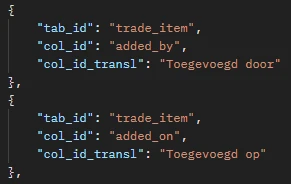
The following URL works.

{{indicium_url}}/iam/iam/i_ui_col?gui_appl_alias={{gui_appl_alias}}&$filter=tab_id eq 'trade_item'&$select=tab_id,col_id,col_id_transl

Translations are in Dutch (as expected) because the user is set to Dutch in IAM. 


Which translation is returned? The ‘standard’ translation or transl_grid/transl_form/transl_plural?


Mark Jongeling
Administrator
Forum|alt.badge.img+23

The translation returned in this view is the standard singular translation. If you want the grid or form translation instead, the i_ui_col_grid or i_ui_col_form view can be called.

Having the Alternative translation option on may return a different translation that you initially expected, as the translation now comes from the alternative column.


Jochem Pieper
Moderator
Forum|alt.badge.img+3

Thanks for the follow-up! The column col_id_transl is the standard translation (transl). If the column uses an alternative label, that one is already applied, so you get what the user actually sees.

The grid and form labels are in separate views, with the same keys as i_ui_col:

  • i_ui_col_grid → grid_transl
  • i_ui_col_form → form_transl

For example:

{{indicium_url}}/iam/iam/i_ui_col_grid?gui_appl_alias={{gui_appl_alias}}&$filter=tab_id eq 'trade_item'&$select=tab_id,tab_variant_id,col_id,grid_transl

There is no plural for columns as that only applies to tables. For the table itself (the tab_id in your query) you can get both the singular and plural translation from i_ui_tab:

{{indicium_url}}/iam/iam/i_ui_tab?gui_appl_alias={{gui_appl_alias}}&$filter=tab_id eq 'trade_item'&$select=tab_id,tab_variant_id,tab_id_transl,tab_id_transl_plural

One tip: these views return a row per table variant. Add and tab_variant_id eq '' to your filter to get only the default (non-variant) labels, if you use table variants in your situation at all.